
The /b/ sound is made by pressing your lips together and using your voice to create sound. Follow these steps to teach the /b/ sound:
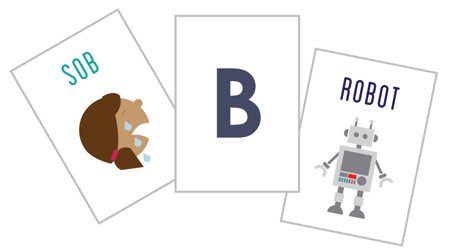
Step-by-Step Instructions:
- Press your lips together: Close your lips tightly.
- Feel the air build up behind your lips: As you prepare to make the sound, notice the air accumulating behind your lips.
- Turn your voice box on: Make your throat vibrate by engaging your vocal cords.
- Release the pressure in a puff of air: Explode the air out while vibrating your throat. Give it a try!
Helpful Tips for Teaching the /B/ Sound:
- Remind the child to close their lips and puff out their cheeks to help control the airflow.
- Avoid adding an 'uh' sound after the /b/: For example, say /b/ (not /buh/). This is called isolating the sound and helps the child focus on producing the sound without extra vowel sounds.
- Use a piece of string or tissue: Hold up a small piece of string or tissue and ask the child to make it “dance” by releasing the puff of air. This helps them understand the explosive nature of the /b/ sound.
- Demonstrate on the child’s hand: Show them how the /b/ sound feels by blowing air onto their hand. Have them do the same to their own hand to feel the air pressure and vibration.
- Use the voice box: The /b/ and /p/ sounds are similar. The tongue placement and airflow are the same in both. However, with /b/, the voice box is turned on (e.g., "big," "robin," "tub"), while with /p/, the voice box is off (e.g., "pig," "hippo," "nap"). Have the child place their hand lightly on their throat while saying these words to feel the difference.
Common Errors:
- Substituting a /p/ for a /b/: This is the most common error, where the child turns off their voice box instead of turning it on. If the child says a /p/ sound instead of a /b/, have them hum before attempting the sound again. Humming will help them activate their voice box.
Important Note:
Do not practice the sound incorrectly. If, after a few attempts, the child continues to say the sound incorrectly, stop and reach out to a speech-language pathologist for assistance. These tips and tricks are not intended to replace the guidance of a licensed professional, and practicing the sound incorrectly may cause more harm than good.
References:
Secord, W. A., Boyce, S. E., Donohue, J. S., Fox, R. A., & Shine, R. E. (2007). Eliciting Sounds: Techniques and Strategies for Clinicians (2nd ed.). Delmar, Cengage Learning.
© 2024 At Home Articulation, Inc. All Rights Reserved.