
To produce the /f/ sound, follow these simple steps:
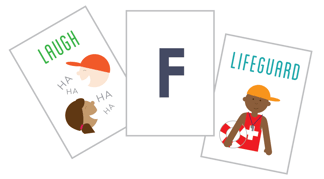

- Place your upper teeth lightly on your bottom lip.
- Gently bite down on your lower lip.
- Softly blow air over your bottom lip. Give it a try!
Helpful Tips:
-
Visual Feedback: Use a mirror to help monitor your child’s progress and provide visual feedback.
-
Isolate the Sound: When teaching or practicing a sound, it’s important that you do not add an ‘uh’ after the sound. For example, avoid saying /f/ vs /fuh/. Adding the ‘uh’ vowel after the sound can be confusing for the child. This process is called "isolating the sound" in speech therapy.
-
Tiny Bite Technique: Instruct your child to bite down on their lower lip. You can tell them to make it a "tiny bite." Next, ask them to hold their hand up to their lips and blow out air.
-
Finger Assistance: Gently use your finger to lift your child’s lower lip to touch their top teeth, then instruct them to blow out air.
-
Difference Between /F/ and /V/: /F/ and /V/ are similar sounds, as they both involve the same teeth placement and airflow. However, when making the /f/ sound, the voice box is not turned on (e.g., in words like fast, wafer, leaf). On the other hand, the voice box is turned on when making the /v/ sound (e.g., in words like vacuum, oven, love). Have the child place their hand lightly on their throat while saying these words to feel the difference between when the voice box is on and off.
Common Errors:
-
/V/ Sound: If the child produces a /v/ sound instead of a /f/, it means they are turning on their voice box. To correct this, remind the child to turn off their voice box and try again. You can have them place their hand lightly on their throat while switching between the /f/ and /v/ sound to feel the difference.
-
/P/ or /B/ Sound: If you hear a /p/ or /b/ sound, the child may be "stopping" the airflow (e.g., saying "pish" for "fish"). This means they are closing their lips, building up pressure, and then releasing the air too forcefully. Remind them to gently bite their bottom lip and blow air softly to correct the sound.
Important Note:
Do not practice the sound incorrectly! If after a few tries the child continues to say the sound incorrectly, stop and reach out to a speech-language pathologist for help. These tips and tricks are not intended to replace the guidance of a licensed speech-language pathologist. Practicing the sound incorrectly can cause more harm than good.
References:
-
Secord, W. A., Boyce, S. E., Donohue, J. S., Fox, R. A., & Shine, R. E. (2007). Eliciting Sounds, Techniques and Strategies for Clinicians (2nd edition). Delmar, Cengage Learning.
© 2024 At Home Articulation, Inc. All Rights Reserved.