![facebook_logo-01-1.png]](https://wiki.athomearticulation.com/hs-fs/hubfs/facebook_logo-01-1.png?height=50&name=facebook_logo-01-1.png)
Overview
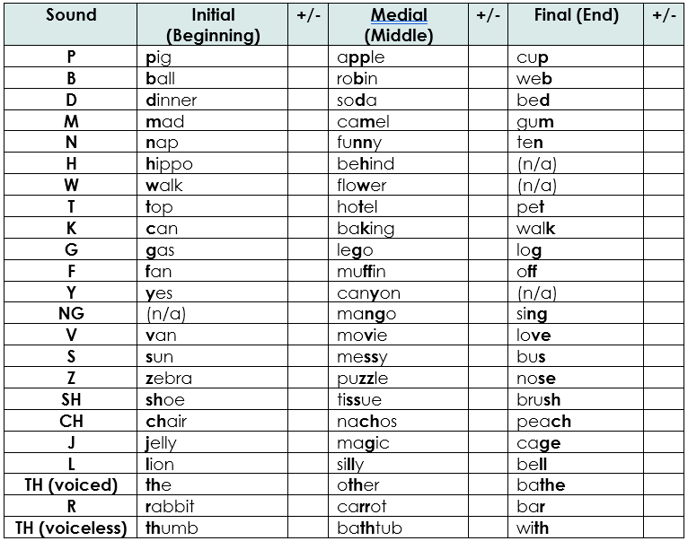
This quick screener is designed to help you identify which speech sounds your child may be struggling to pronounce. You’ll listen to how your child says different sounds in the beginning, middle, and end of words. This tool will guide you in knowing what sound, word position, and practice level to focus on.
👉 Before You Begin:
-If you haven't yet, visit www.athomearticulation.com to start your free 2-week trial. This screener works best when paired with the full At Home Articulation system.
Print the screener by clicking this link: [Speech Sound Screener]
Step 1: Preparation
-
Sit in a quiet room with your child.
-
Have your child sit facing you, so you can clearly watch their mouth while they speak.
-
Say each word aloud, one at a time, and ask your child to repeat it.
-
Focus only on the bolded sound in each word.
-
✔️ Mark it correct (+) if they say the bolded sound accurately, even if the rest of the word is incorrect.
-
❌ Mark it incorrect (-) if they do not say the bolded sound correctly.
-
Step 2: Encouragement
-
Avoid correcting your child during the activity.
-
Don’t tell them whether their response was right or wrong. Instead, offer positive encouragement, such as:
-
“You’re working so hard!”
-
“Way to stay focused!”
-
-
If your child refuses a word, skip it and return to it later.
Step 3: After You Finish
- You'll find simple instructions to help you know exactly which sound to start practicing with your child first.


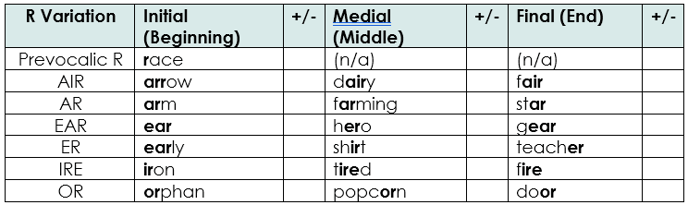
👉 Note: If your child has trouble with R words, don’t worry! We’ve included a more detailed R Screener just for this tricky sound. R can change depending on the sounds around it — these are called R variations, and they're one of the most common sounds kids need extra practice with. Some R variations may start with a vowel sound, but they’re still considered R sounds.
After the Speech Screener: What to Practice First
Now that you've completed the speech screener, use the steps below to figure out which speech sound to start practicing with your child.
- Identify the Sounds to Work On
First, look at your child's screener results. Circle all of the incorrect or minus marks (-). Which sound(s) and word position(s) do they need help with? (Examples: S-initial, L-final, K-initial). Write them in the space below: - Put the Sounds in Developmental Order
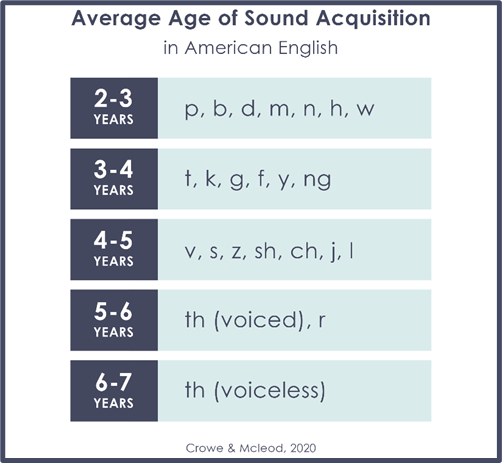
Using the Average Age of Sound Acquisition chart below, list the sounds (ignore the word positions) in the order children typically learn them—from earliest to latest.
(Example: K, then S, then L). Write them in the space below: - Picking the Right Sound to Practice First
Go to the Parent Portal and look under Resources > Tips and Tricks as well as Word Lists for the sounds your child had trouble with.
- Try the first (earliest developing) sound on your list.
- Use the strategies in the Tips and Tricks to see if your child can say some of the words in the Word List with your help.
- ✅ If they can say it correctly with your support, that’s the best sound to start practicing!
- ❌ If they can’t say any of the words correctly, that’s okay— Move onto the next sound from your speech screener results and repeat the same process using the Tips and Tricks and Word Lists.
- If your child isn’t able to say any of the sounds correctly in single words, this is your cue to contact a licensed speech-language pathologist.
Step 4: Play a Game!
-
- Now that you know what sound to practice, head to the Practice Portal:
- Select the sound you identified to practice first
- Choose the word position (beginning, middle, or end)
- Pick the level that fits your child’s needs
- Not sure what word position or level to choose? No worries—we’ve included quick 60-second tutorials right in the Practice Portal to help you decide confidently.
- Select a fun game and hit “Let’s Play!”
- Now that you know what sound to practice, head to the Practice Portal: